The cloud is a broad concept that encompasses servers and distributed computing accessible over the internet. In this discussion, I will explain how my understanding of computer science fundamentals helped me choose the right tools to solve a real problem I encountered while developing a chess gaming website. But first, let's define some key concepts related to this topic.
Definitions:
- REST API: A program that handles client requests, connects to a database, serves data, and manages authentication. It shouldn't do heavy CPU workloads as it could affect other client connections.
- Horizontal Scaling: When more compute is needed more servers are added to the infrastructure, for this problem GCP functions provide on demand scaling very cheaply.
- Vertical Scaling: The resources of the server are increased, a better CPU is added or more RAM or storage. Its the simpler solution, and it could be helpful if the server is unable to handle that many concurrent solutions. It’s not effective if individual requests are bottlenecking CPU usage, as the issue is with the processing power for each request, not overall server capacity.
- Layering: This is a common a design pattern for API design. The logic for each endpoint is generally separated in this layers.
- Authentication Layer: Verifies user identity and controls access.
- Data Access Layer: Retrieves and stores data in the database.
- Service Layer: Processes retrieved data, applying small computations before returning a response.
- CPU-Bound Task: A short computation-heavy process in the Service layer that manipulates or analyzes retrieved data before responding.
- Cloud function: A serverless REST endpoint that behaves like a pure function, meaning that for a given input X, it always returns the same output Y. Cloud functions are highly data-dependent and stateless, meaning they do not retain state between invocations.
- Minimax: An algorithm for building a tree from all possible positions in a game and then selecting the best one. This places high strain on the CPU.
What was the issue on my platform?
I am currently developing a chess platform where a player can challenge some premade AI bots. There was an endpoint that received the board state and the strategy that the player wanted to play against. This was working fine on a medium-sized EC2 instance, well, until I introduced a feature for streaming bot-vs-bot games.
With each connection to the streaming endpoint the minimax algorithm had to be executed back and forth causing a massive spike on CPU usage. I decided to make a stress test with just 3 simultaneous games and CPU quickly shot past 100%, crashing the container. Out of curiosity I upgraded to a larger $250 a month instance (Vertical scaling) and run the same tests, and not surprisingly with 5 players streaming games the server crashed.
These findings led me to reconsider the role of an API. Through some reading, I found that performing CPU-intensive tasks is not typically part of its function. Yes, an API could handle a couple of hundred connections until it hits a limit, at which point I would need to upgrade. However, it shouldn't crash with just 3 or 5 game streams.
Solution
Given that the task of an API is not to burn through CPU usage, my current approach was totally wrong. The only solution was to remove minimax from the server, as the definition of an API does not include to burn CPU usage on a single request.
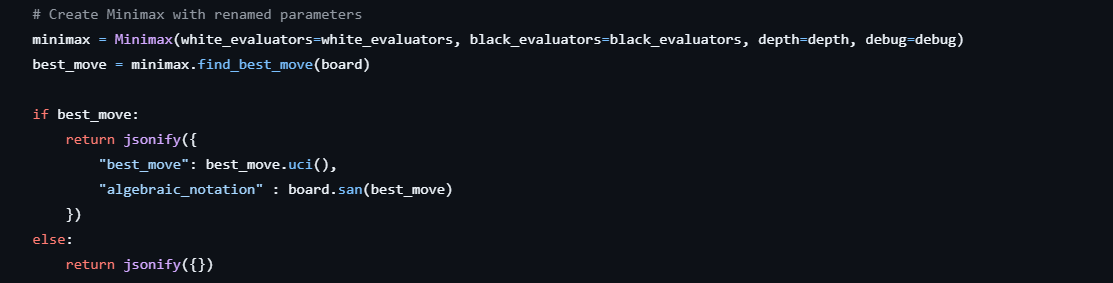
The original endpoint ran Minimax for each connected client on the same server, causing CPU spikes. To fix this, I moved Minimax to a separate service.
After that I realized that thanks to the well-layered design of the API, it was easy to remove the Minimax algorithm from the service layer and replace it with a request to a service that could handle the task. The service layer for this endpoint was simply a function that took data from the data access layer and returned a single result.
A function? Wait, aren't there Cloud Functions? Sure enough, there are. After reading some documentation, I was pleased to find that Cloud Functions are pure, as defined in functional programming—providing a service where you send payload X and always get the same result back.
The only part that took a bit of time was implementing serialization methods for
the arguments of the Minimax class. Notice that it accepts four parameters. I wrote a
.to_json() and .from_json() method for the cloud function
to deconstruct and reconstruct the inputs. Here's a code snippet illustrating the
changes:
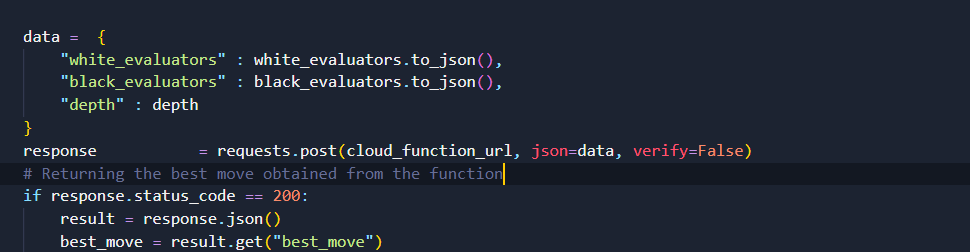
The server code does not contain any CPU-bound tasks. The minimax 'inference' was replaced by sending a network request and waiting for it.
After moving the existing Minimax class to a separate folder and implementing the necessary code to deserialize the payload and reconstruct the inputs, the next logical step was to evaluate the new approach—using Cloud Functions.
Cloud functions review
With this new architecture in place, I turned my attention to assessing whether Cloud Functions would be a viable and cost-effective solution. After researching the service’s pricing model, I realized it was a perfect fit for my needs. Cloud Functions are priced based on CPU time and the number of invocations, which seemed ideal for my use case. To ensure the solution was economically viable, I ran a few calculations:
A full game stream requires up to 150 invocations, and with 100 players streaming 10 games daily, the total monthly cost would be about $45. This allowed me to downgrade the server to an EC-small, where its only role was to store game data, handle matchmaking, and manage game streaming by calling the cloud function.
If this project takes off, I might need to move the function to another language like C or Rust, but for the moment being, Python is good enough.
Some conclusions
What was needed to solve this problem? Was it necessary to take a certification of cloud technologies? Not at all, I think the three concepts that were needed where the following:
- Follow the REST principles: From the beginning the API was following the philosophy of rest, even though at the beginning the code is more verbose, without this clean architecture separating the CPU-Bound task which was bringing the server down would be really hard. In this case the only challenge was to implement serialization methods on some existing classes.
- API Design: I want to emphasize how important it is to understand the responsibilities of an API. In this case, recognizing which tasks should and shouldn't be the API's responsibility was crucial. The API's job is to manage communication between components and ensure smooth data flow, but CPU-intensive tasks like the Minimax algorithm should be offloaded to other services designed to handle such workloads.
- Pure functions: Understanding the concept of pure functions was key to solving the problem. The bottleneck in this scenario stemmed from the Minimax function itself, and recognizing that I had to work on serializing this classes so they could be offloaded to a different service.
With these insights in mind, it became easy to ask AI for guidance on the right tools to look up in Google Cloud. Additionally, this understanding enabled me to make quick cost estimations and motivated me to tackle the problem hands-on. After making this changes I tested the server running multiple games and the CPU usage didn't spike at all. For the moment the costs are fine for the size of the project.
I cannot agree more, fantastic read about cloud scaling!